Topic summary
Expected utility
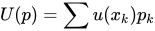
Extracted from the Wikipedia article Expected utility hypothesis.
The von Neumann–Morgenstern axioms
In other words, if an individual's behavior always satisfies the above axioms, then there is a utility function such that the individual will choose one gamble over another if and only if the expected utility of one exceeds that of the other. The expected utility of any gamble may be expressed as a linear combination of the utilities of the outcomes, with the weights being the respective probabilities. Utility functions are also normally continuous functions. Such utility functions are also called von Neumann–Morgenstern (vNM). This is a central theme of the expected utility hypothesis in which an individual chooses not the highest expected value but rather the highest expected utility. The expected utility-maximizing individual makes decisions rationally based on the theory's axioms.