|
Komaba-tōdaimae Station
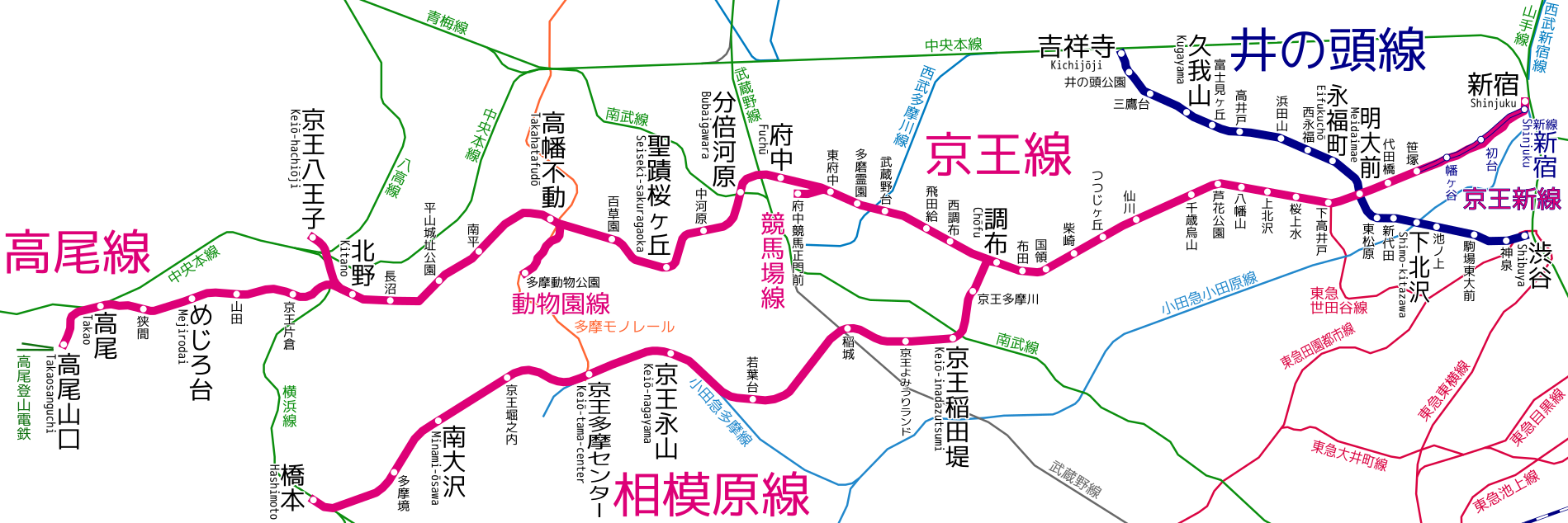
is a railway station on the Keio Inokashira Line in Komaba, Meguro, Tokyo, Japan, operated by the private railway operator Keio Corporation. The station's name is a combination of Komaba, the name of the suburb in which it is located, and Todai-mae - which means "in front of University of Tokyo". Lines Komaba-tōdaimae Station is served by the 12.7 km Keio Inokashira Line from in Tokyo to . Located between and , it is 1.4 km from the Shibuya terminus. Service pattern Only all-stations "Local" services stop at this station. On special occasions in November the express train will stop at the station temporarily. Station layout There are two main exits from the station, East and West. The East Exit is close to the main entrance to the Komaba campus of the University of Tokyo, and to the central part of Komaba. The West Exit leads to Komaba 2, 3, and 4 Japanese addressing system, chōme. The station has one island platform, serving two tracks. Because the station is ... [...More Info...] [...Related Items...] OR: [Wikipedia] [Google] [Baidu] [Amazon] |
Meguro, Tokyo
is a Special wards of Tokyo, special ward in the Tokyo, Tokyo Metropolis in Japan. The English translation of its Japanese self-designation is Meguro City. The ward was founded on March 15, 1947. Meguro is predominantly residential in character, but is also home to light industry, corporate head offices, the Komaba campus of University of Tokyo as well as fifteen foreign embassies and consulates. Residential neighborhoods include, Jiyugaoka, Kakinokizaka, and Nakameguro, Meguro, Tokyo, Nakameguro. As of May 1, 2015, the ward has an estimated population of 277,171 and a population density of 18,890 persons per km2. The total area is 14.67 km2. Meguro is also used to refer to the area around Meguro Station, which is not located in Meguro ward, but in neighboring Shinagawa's Kamiōsaki, Shinagawa, Tokyo, Kamiōsaki district. History The Higashiyama shell mound in the north of the ward contains remains from the Paleolithic, Jōmon, Yayoi, and Kofun periods. The area now kno ... [...More Info...] [...Related Items...] OR: [Wikipedia] [Google] [Baidu] [Amazon] |
Tokyo
Tokyo, officially the Tokyo Metropolis, is the capital of Japan, capital and List of cities in Japan, most populous city in Japan. With a population of over 14 million in the city proper in 2023, it is List of largest cities, one of the most populous urban areas in the world. The Greater Tokyo Area, which includes Tokyo and parts of six neighboring Prefectures of Japan, prefectures, is the most populous metropolitan area in the world, with 41 million residents . Lying at the head of Tokyo Bay, Tokyo is part of the Kantō region, on the central coast of Honshu, Japan's largest island. It is Japan's economic center and the seat of the Government of Japan, Japanese government and the Emperor of Japan. The Tokyo Metropolitan Government administers Tokyo's central Special wards of Tokyo, 23 special wards, which formerly made up Tokyo City; various commuter towns and suburbs in Western Tokyo, its western area; and two outlying island chains, the Tokyo Islands. Although most of the w ... [...More Info...] [...Related Items...] OR: [Wikipedia] [Google] [Baidu] [Amazon] |
Keio Corporation
is a private railway operator in Tokyo, Japan and the central firm of the that is involved in transport, retailer, retail, real estate and other industries. The Keio railway network connects western suburbs of Tokyo (Chōfu, Tokyo, Chōfu, Fuchū, Tokyo, Fuchū, Hachiōji, Tokyo, Hachiōji, Hino, Tokyo, Hino, Inagi, Tama, Tokyo, Tama) and Sagamihara in Kanagawa Prefecture, Kanagawa with central Tokyo at Shinjuku Station. The name is derived from taking one character each from the places through which the railway runs: and . Network overview Lines The Keio network is based around the central Keiō Line, , 32 stations. The Keio Inokashira Line does not share track with the Keio Main Line. It intersects with the Keio Line at Meidaimae Station. History The company's earliest predecessor was the founded in 1905. In 1906 the company was reorganized as the , and in 1910 was renamed yet again to . It began operating its first stretch of interurban between Sasazuka and Chōf ... [...More Info...] [...Related Items...] OR: [Wikipedia] [Google] [Baidu] [Amazon] |
Keio Inokashira Line
The is a railway line operated by the Japanese private railway operator Keio Corporation in the western suburbs of Edo, connecting in Tokyo with in Musashino, Tokyo, Musashino City. It is not physically connected to the Keiō Line, Keio Main Line Network, but a transfer is available at Meidaimae Station. This line is gauge, unlike other Keio lines which are gauge. Operation Keio operates two types of trains on the line: all-stations or () services and limited-stop services. During the daytime off-peak, one local and one express operate every 8 minutes on the line. Stations All stations are in Tokyo. History The line opened in 1933, dual track connecting Shibuya in Tokyo to , owned by , part of the Odakyu Group. The track gauge used was the same as for other Odakyu lines, and the overhead power supply was 600 V DC. The line was extended to in April 1934. In May 1940, the company merged with the Odakyu Electric Railway, and on 1 May 1942, Odakyu merged with to become ... [...More Info...] [...Related Items...] OR: [Wikipedia] [Google] [Baidu] [Amazon] |
Komaba, Meguro, Tokyo
is a residential neighborhood in the northern area of Meguro, Tokyo, Japan. Consisting of four districts, the neighborhood has a population of 6,847. The neighborhood is known as a center for education being the location of a number of selective entry high schools and the Komaba Campus of the University of Tokyo The University of Tokyo (, abbreviated as in Japanese and UTokyo in English) is a public research university in Bunkyō, Tokyo, Japan. Founded in 1877 as the nation's first modern university by the merger of several pre-westernisation era ins .... Geography Komaba borders Uehara and Tomigaya in the north, Shōtō, Shinsenchō and Aobadai to the east, Ohashi and Ikejiri to the south, and Daizawa and Kitazawa to the west. Landmarks * University of Tokyo, Komaba Campus incorporating the Graduate School of Art and Science, the Graduate School of Mathematics, the Institute of Industrial Science Research, and the Research Center for Advanced Science and Te ... [...More Info...] [...Related Items...] OR: [Wikipedia] [Google] [Baidu] [Amazon] |
University Of Tokyo
The University of Tokyo (, abbreviated as in Japanese and UTokyo in English) is a public research university in Bunkyō, Tokyo, Japan. Founded in 1877 as the nation's first modern university by the merger of several pre-westernisation era institutions, its direct precursors include the '' Tenmongata'', founded in 1684, and the Shōheizaka Institute. Although established under its current name, the university was renamed in 1886 and was further retitled to distinguish it from other Imperial Universities established later. It served under this name until the official dissolution of the Empire of Japan in 1947, when it reverted to its original name. Today, the university consists of 10 faculties, 15 graduate schools, and 11 affiliated research institutes. As of 2023, it has a total of 13,974 undergraduate students and 14,258 graduate students. The majority of the university's educational and research facilities are concentrated within its three main Tokyo campuses: Hongō, ... [...More Info...] [...Related Items...] OR: [Wikipedia] [Google] [Baidu] [Amazon] |
Japanese Addressing System
The Japanese addressing system is used to identify a specific location in Japan. When written in Japanese characters, addresses start with the largest geographical entity and proceed to the most specific one. The Japanese system is complex, the product of the natural growth of urban areas, as opposed to the systems used in cities that are laid out as grids and divided into quadrants or districts. When written in Latin alphabet, Latin characters, addresses follow the convention used by most Address format, Western addresses and start with the smallest geographic entity (typically a house number) and proceed to the largest. However, even when translated using Latin characters, Japan Post requires that the address also is written in Japanese to ensure correct delivery. Address parts Japanese addresses begin with the largest division of the country, the Prefectures of Japan, prefecture. Most of these are called , but there are also three other special prefecture designations: fo ... [...More Info...] [...Related Items...] OR: [Wikipedia] [Google] [Baidu] [Amazon] |
Island Platform
An island platform (also center platform (American English) or centre platform (British English)) is a station layout arrangement where a single platform is positioned between two tracks within a railway station, tram stop or transitway interchange. Island platforms are sometimes used between the opposite-direction tracks on twin-track route stations as they are cheaper and occupy less area than other arrangements. They are also useful within larger stations, where local and express services for the same direction of travel can be accessed from opposite sides of the same platform instead of side platforms on either side of the tracks, simplifying and speeding transfers between the two tracks. The historical use of island platforms depends greatly upon the location. In the United Kingdom the use of island platforms on twin-track routes is relatively common when the railway line is in a cutting or raised on an embankment, as this makes it easier to provide access to the platf ... [...More Info...] [...Related Items...] OR: [Wikipedia] [Google] [Baidu] [Amazon] |
Elevator
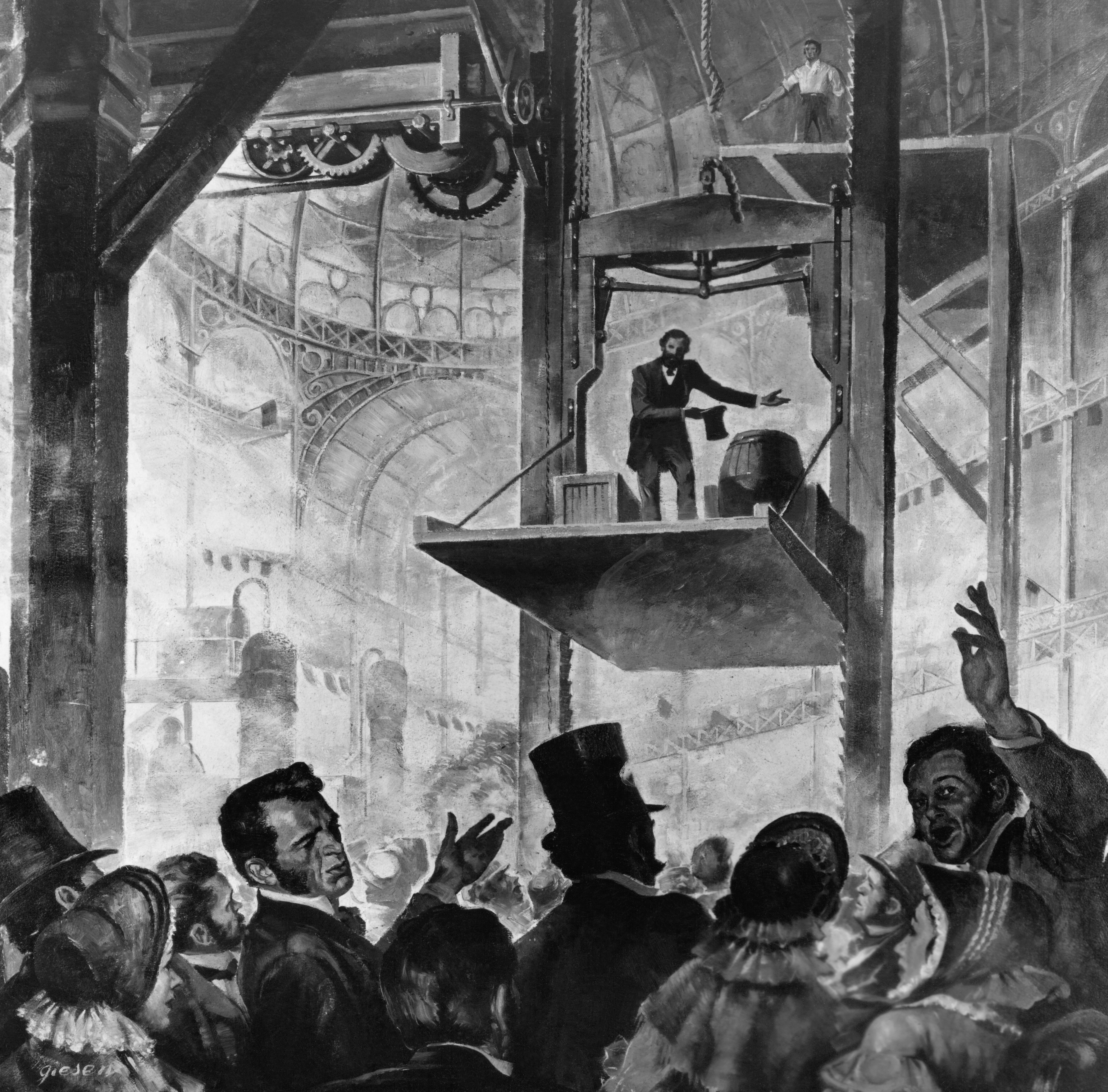
An elevator (American English) or lift (Commonwealth English) is a machine that vertically transports people or freight between levels. They are typically powered by electric motors that drive traction cables and counterweight systems such as a hoist, although some pump hydraulic fluid to raise a cylindrical piston like a jack. Elevators are used in agriculture and manufacturing to lift materials. There are various types, like chain and bucket elevators, grain augers, and hay elevators. Modern buildings often have elevators to ensure accessibility, especially where ramps aren't feasible. High-speed elevators are common in skyscrapers. Some elevators can even move horizontally. History Pre-industrial era The earliest known reference to an elevator is in the works of the Roman architect Vitruvius, who reported that Archimedes ( – ) built his first elevator probably in 236 BC. Sources from later periods mention elevators as cabs on a hemp rope, powered by people o ... [...More Info...] [...Related Items...] OR: [Wikipedia] [Google] [Baidu] [Amazon] |
University Of Tokyo, Komaba Campus
The Komaba Campus, University of Tokyo is one of the three main Tokyo campuses of the University of Tokyo. It is divided into two sections; Komaba I and II. The former is home to the College of Arts and Sciences, University of Tokyo, College of Arts and Sciences, the Department of Mathematics of the Faculty of Science, and their affiliated graduate school (the Graduate School of Arts and Sciences and the Graduate School of Mathematical Sciences respectively). The latter does not offer undergraduate programmes and is mainly used by the Research Centre for Advanced Science and Technology (RCAST) and the Institute of Industrial Science (IIS). After matriculating at UTokyo, all undergraduates begin their academic journey at Komaba I, which encompasses the first one and a half years of their degrees. Approximately 10 per cent of students opt to continue their education at Komaba beyond the junior division, matriculating at either the College of Arts and Sciences or the Department of ... [...More Info...] [...Related Items...] OR: [Wikipedia] [Google] [Baidu] [Amazon] |
National Center For University Entrance Examinations
The is an Independent Administrative Institution that administers the National Center Test for University Admissions and law school entrance exams in Japan. The institution is under the control of the Ministry of Education, Culture, Sports, Science and Technology. Its offices are located in Komaba, Meguro, Tokyo. History * 1977 Established as the preparation organization for the Common first-stage exam * 1979 First common first-stage exam * 1988 Started providing information on universities through the videotex with its '' Heart System'' (ハートシステム) * 1990 Became the administrator of the National Center Test for University Admissions * 2003 Began administering law school entrance exams See also * Independent Administrative Institution An , or Independent Administrative Institution, is a type of legal corporation formulated by the Government of Japan under the Act on General Rules for Incorporated Administrative Agencies (Act no. 103 of 1999, revised in 2014). The ... [...More Info...] [...Related Items...] OR: [Wikipedia] [Google] [Baidu] [Amazon] |
Japanese Folk Crafts Museum
The is a museum in the 4th city block of Komaba, Meguro Ward, Tokyo, Japan, dedicated to the collecting, preserving, researching, and exhibition of the hand-crafted art of ordinary people, mingei, often translated as folk crafts. Access is from Komaba-Tōdaimae Station of Keio Inokashira Line. The museum covers 1,818 square meters and was constructed with a traditional Japanese architectural style. A 'long' stone-roofed gate-cum-residence (''nagaya-mon'') was brought from Tochigi Prefecture and reconstructed in front of the building. History Founded in 1936 by Yanagi Sōetsu, a religious philosopher, scholar, art researcher, and advocate in researching folk crafts. It is currently managed by The Japanese Folk Crafts Museum Foundation, a public interest corporation (The Japanese Folk Crafts Museum Foundation, Corporate Number (Assigned by Japan's National Tax Agency)9013205001720) operating from the museum. Before Opening The founder, Yanagi Sōetsu, wanted to showcase va ... [...More Info...] [...Related Items...] OR: [Wikipedia] [Google] [Baidu] [Amazon] |