|
Bunkyō
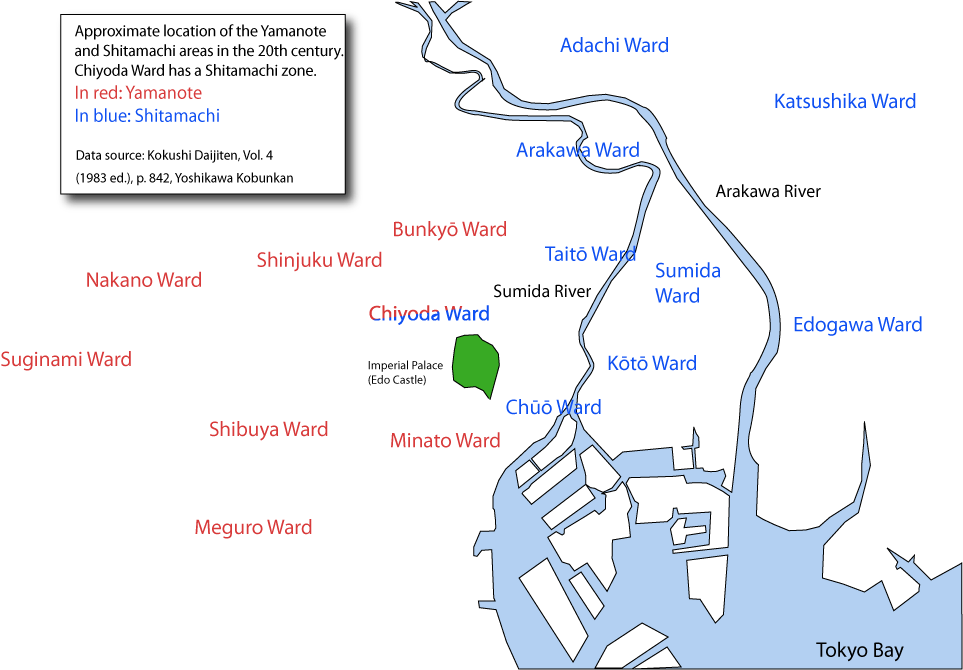
is a Special wards of Tokyo, special ward in the Tokyo, Tokyo Metropolis in Japan. Situated in the middle of the ward area, Bunkyō is a residential and educational center. Beginning in the Meiji period, literati like Natsume Sōseki, as well as scholars and politicians have lived there. Bunkyō is home to the Tokyo Dome, Judo's Kodokan Judo Institute, Kōdōkan, and the University of Tokyo's Hongō campus, Hongo Campus. It was formed in 1947 as a merger of Hongo and Koishikawa wards following Tokyo City's Local Autonomy Act, transformation into Tokyo Metropolis. The modern Bunkyo ward exhibits contrasting Shitamachi and Yamanote geographical and cultural division. The Nezu and Sendagi neighborhoods in the ward's eastern corner is attached to the Shitamachi area in Ueno. On the other hand, the remaining areas of the ward typically represent Yamanote districts. As of 2022, the ward has a population of 240,069 (including about 8,500 foreign residents), and a population density of . ... [...More Info...] [...Related Items...] OR: [Wikipedia] [Google] [Baidu] [Amazon] |
Tokyo
Tokyo, officially the Tokyo Metropolis, is the capital of Japan, capital and List of cities in Japan, most populous city in Japan. With a population of over 14 million in the city proper in 2023, it is List of largest cities, one of the most populous urban areas in the world. The Greater Tokyo Area, which includes Tokyo and parts of six neighboring Prefectures of Japan, prefectures, is the most populous metropolitan area in the world, with 41 million residents . Lying at the head of Tokyo Bay, Tokyo is part of the Kantō region, on the central coast of Honshu, Japan's largest island. It is Japan's economic center and the seat of the Government of Japan, Japanese government and the Emperor of Japan. The Tokyo Metropolitan Government administers Tokyo's central Special wards of Tokyo, 23 special wards, which formerly made up Tokyo City; various commuter towns and suburbs in Western Tokyo, its western area; and two outlying island chains, the Tokyo Islands. Although most of the w ... [...More Info...] [...Related Items...] OR: [Wikipedia] [Google] [Baidu] [Amazon] |
Kodokan Judo Institute
The , or ''Kōdōkan'' (講道館), is the headquarters of the worldwide judo community. The ''kōdōkan'' was founded in 1882 by Kanō Jigorō, the founder of judo, and is now an eight-story building in Tokyo. Etymology Literally, ''kō'' (講) means "to lecture", ''dō'' (道) means " way," and ''kan'' (館) is "a public building". Together it can be translated as "a place for the study of the way." Function The Kodokan Institute offers classes for those who want to master judo. The program is authorized as a non-regular school by the Tokyo Metropolitan Government. Its courses include the theories and practice of judo, and matters of general education. The course is divided into two parts: a general course for novices, and special courses for those who have completed the general course or its equivalent. The Kodokan also issues ranks, and many ''judoka'' (practitioners of judo) around the world become Kodokan members and have their ranks registered with the Kodokan. Th ... [...More Info...] [...Related Items...] OR: [Wikipedia] [Google] [Baidu] [Amazon] |
Tokyo Dome
is an indoor stadium in Bunkyō, Tokyo, Japan. It was designed as a baseball stadium following its predecessor, Korakuen Stadium (whose former site is now occupied by the Tokyo Dome Hotel and a plaza for this stadium). In Japan, it is often used as a unit of size; for example, "the new construction is five times the size of Tokyo Dome." Construction Construction on the stadium began on May 16, 1985, and it opened on March 17, 1988. It was built on the site of the Velodrome, adjacent to Korakuen Stadium and the Koishikawa-Kōrakuen garden. It has a maximum total capacity of 57,000 depending on configuration, with an all-seating configuration of 42,000. Tokyo Dome's original nickname was "The Big Egg", with some calling it the "Tokyo Big Egg".Haberman, Clyde Amid Some Doubts, a Tokyo Dome New York Times, March 23, 1988 Its dome-shaped roof is an air-supported structure, a cable-reinforced 0.8 mm flexible fiberglass membrane supported by slightly pressurizing the inside of the ... [...More Info...] [...Related Items...] OR: [Wikipedia] [Google] [Baidu] [Amazon] |
University Of Tokyo
The University of Tokyo (, abbreviated as in Japanese and UTokyo in English) is a public research university in Bunkyō, Tokyo, Japan. Founded in 1877 as the nation's first modern university by the merger of several pre-westernisation era institutions, its direct precursors include the '' Tenmongata'', founded in 1684, and the Shōheizaka Institute. Although established under its current name, the university was renamed in 1886 and was further retitled to distinguish it from other Imperial Universities established later. It served under this name until the official dissolution of the Empire of Japan in 1947, when it reverted to its original name. Today, the university consists of 10 faculties, 15 graduate schools, and 11 affiliated research institutes. As of 2023, it has a total of 13,974 undergraduate students and 14,258 graduate students. The majority of the university's educational and research facilities are concentrated within its three main Tokyo campuses: Hongō, ... [...More Info...] [...Related Items...] OR: [Wikipedia] [Google] [Baidu] [Amazon] |
Bunkyo Civic Center
The is the government building for Bunkyo ward in Tokyo, Japan. Its 25th floor houses a free observation deck. The building was completed in 1994. It has been described as a "colossal Pez candy dispenser" by ''The Japan Times''. The building is near the Tokyo Dome, Tokyo Dome Hotel, Tokyo Dome City, and Tokyo Dome City Attractions. History Bunkyo Civic Center stands on the former site of the Bunkyo City Hall (), which opened in April 1959. This was the venue for the first Japan Record Awards. The city hall, which had excellent acoustics, was used mainly as a venue for classical music performances and concerts from the time of its opening until 1977. In 1977 the building was found in violation of fire safety regulations imposed by the Japanese government, and was closed down. The government demolished the city hall and rebuilt it as a government building named Bunkyo Civic Center. The tall civic center includes three basement floors and 28 floors above-ground, making it th ... [...More Info...] [...Related Items...] OR: [Wikipedia] [Google] [Baidu] [Amazon] |
Koishikawa Botanical Garden
The is a botanical garden with an arboretum operated by the University of Tokyo Graduate School of Science. They are located at 3-7-1 Hakusan, Bunkyō, Tokyo, Japan, and open daily except Mondays; an admission fee is charged. History The Tokugawa shogunate opened two gardens in 1638 in Azabu and Ōtsuka neighborhoods of Edo for the purposes of growing medicinal herbs. In 1684, the Azabu gardens were abolished and relocated to Koishikawa, to the site of a villa owned by Shogun Tokugawa Tsunayoshi. At the time, it was called the . During the time of Shogun Tokugawa Yoshimune, the entire site of Tsunayoshi's former villa was given over to the garden. In 1722, in response to a petition made to Yoshimune's famous "suggestion box" by town doctor Ogawa Tadafune for a medical clinic to serve the needs of the lower classes, the ''machi-bugyō'' of Edo, Ōoka Tadasuke was ordered to create the Koishikawa Yojosho clinic. In 1877, after the Meiji Restoration, the gardens became a par ... [...More Info...] [...Related Items...] OR: [Wikipedia] [Google] [Baidu] [Amazon] |
Koishikawa, Tokyo
is a district of Bunkyo, Tokyo. It consists of five sub-areas, . In Koishikawa are located two well regarded gardens: the Koishikawa Botanical Garden (operated by the University of Tokyo) in Hakusan, and the Koishikawa Korakuen Garden in Kōraku. Train stations for accessing this locality include , , , and Myōgadani Station. The Koishikawa Arsenal was an important military installation during the Meiji era. Education Bunkyo operates the local public elementary and middle schools. Zoned elementary schools are: Kanatomi ( 金富小学校), Kubomachi ( 窪町小学校), Rekisen ( 礫川小学校), and Yanagicho ( 柳町小学校). Zoned junior high schools are: No. 1 ( 第一中学校), No. 3 ( 第三中学校), and Meidai ( 茗台中学校). Koishikawa High School is operated by the Tokyo Metropolitan Government Board of Education. In addition the metropolis operates the Koishikawa Secondary Education School. Image:Koishikawastreets.JPG, Residential street in Koish ... [...More Info...] [...Related Items...] OR: [Wikipedia] [Google] [Baidu] [Amazon] |
Shitamachi
and are traditional names for two areas of Tokyo, Japan. Yamanote refers to the affluent, upper-class areas of Tokyo west of the Imperial Palace.Iwanami Japanese dictionary, 6th Edition (2008), DVD version While citizens once considered it as consisting of Hongo, Kōjimachi, Koishikawa, Ushigome, Yotsuya, Akasaka, Aoyama and Azabu in the Bunkyō, Chiyoda, Shinjuku, and Minato wards, in popular conception, the area extended westwards to include the Nakano, Suginami, and Meguro wards after the Great Kanto Earthquake in 1923. Shitamachi is the traditional name for the area of Tokyo including today the Adachi, Arakawa, Chiyoda (in part), Chūō, Edogawa, Katsushika, Kōtō, Sumida, and Taitō wards, the physically low part of the city along and east of the Sumida River, mostly consisted of commercial areas and chonin residential areas during the Edo period. The two regions have always been vaguely defined, as their identity was more based on culture and caste th ... [...More Info...] [...Related Items...] OR: [Wikipedia] [Google] [Baidu] [Amazon] |
Tokyo City
was a Cities of Japan, municipality in Japan and capital of Tokyo Prefecture (1868–1943), Tokyo Prefecture (or ''Tokyo-fu'') which existed from 1 May 1889 until the establishment of Tokyo Metropolis on 1 July 1943. The historical boundaries of Tokyo City are now occupied by the Special wards of Tokyo, special wards of Tokyo. The defunct city and its prefecture became what is now Tokyo, also known as the Tokyo Metropolis or, ambiguously, Tokyo Prefecture. History In 1868, the city of Edo, seat of the Tokugawa shogunate, Tokugawa government, was renamed Tokyo, and the offices of Tokyo Prefecture (''-fu'') were opened. The extent of Tokyo Prefecture was initially limited to the former Edo city, but rapidly augmented to be comparable with the present Tokyo Metropolis. In 1878, the Meiji government's reorganization of local governments subdivided prefectures into Counties of Japan, counties or districts (''gun'', further subdivided into Towns of Japan, towns and Villages of J ... [...More Info...] [...Related Items...] OR: [Wikipedia] [Google] [Baidu] [Amazon] |
Koishikawa
is a district of Bunkyo, Tokyo. It consists of five sub-areas, . In Koishikawa are located two well regarded gardens: the Koishikawa Botanical Garden (operated by the University of Tokyo) in Hakusan, and the Koishikawa Korakuen Garden in Kōraku. Train stations for accessing this locality include , , , and Myōgadani Station. The Koishikawa Arsenal was an important military installation during the Meiji era. Education Bunkyo operates the local public elementary and middle schools. Zoned elementary schools are: Kanatomi ( 金富小学校), Kubomachi ( 窪町小学校), Rekisen ( 礫川小学校), and Yanagicho ( 柳町小学校). Zoned junior high schools are: No. 1 ( 第一中学校), No. 3 ( 第三中学校), and Meidai ( 茗台中学校). Koishikawa High School is operated by the Tokyo Metropolitan Government Board of Education. In addition the metropolis operates the Koishikawa Secondary Education School. Image:Koishikawastreets.JPG, Residential street in Koish ... [...More Info...] [...Related Items...] OR: [Wikipedia] [Google] [Baidu] [Amazon] |
Mejirodai, Tokyo
Mejirodai () is one of the districts that comprise Bunkyo in Tokyo, Japan. Divided into three sections, It currently has a population of 6,595 as of October 1, 2007. Geography The area is an old residential neighborhood and a school zone. Most notable locations are: *Residence of former Japanese Prime Minister Kakuei Tanaka (His daughter Makiko Tanaka is the current occupant) *Japan Women's University *Eisei Bunko Museum The is a museum in Bunkyo-ku district in Tokyo, Japan. Its collection includes historical documents and artifacts, and works of fine art. The museum is located what was formerly the grounds of the Hosokawa clan, near the Shin-Edogawa Garden. H ... * Wakeijuku Education Bunkyo operates the local public elementary and middle schools. Zoned elementary schools for parts of Meijirodai are: Ooyagi (青柳小学校) and Sekiguchidaimachi ( 関口台町小学校). All of Meijirodai is zoned to Otowa Junior High School ( 音羽中学校). References Dis ... [...More Info...] [...Related Items...] OR: [Wikipedia] [Google] [Baidu] [Amazon] |